Thursday, September 22, 2016

The wild Animals vocabulary

Date: Tuesday, September 13th, 2016
Topic: Wild animals
Framework: PPP
Skill: Vocabulary.
Teachers’ name: Juan Jose Menjivar
Andrea Leiva

In this lesson teachers could start a new unit that was about the animals especially the wild animals. They taught vocabulary and it was a really nice experience for them.
T Juan began the class checking the attendance while T Andrea was giving a name tag to each student. Then, he taught some commands that students were supposed to use in the class. For example: raise your hand, May I go to the bathroom, please, etc.
 Later, Ss had a surprise. T explained them that they were going to do an evaluation, a short quiz that will help them to identify the progress of the previous unit that was about family members. The exam was provided to the students and they did it easily, except two boys that had problems when identifying what they had to do. Both teachers were monitoring their students and clarifying doubts about the exam.

In the warm-up stage, T Juan asked Ss to form a line in the middle of the space they had. There were pasted two colored papers in the floor (one black and the other yellow). When the teacher said yellow all the students had to move to the black paper, but if T said black they moved to the black one. T started to say the color quickly and when one student made a mistake he returned to his desk. Four students were the winners and they receive a sticker as a prize.                                                                            
Later on, T asked students to sit down and he started to teach the wild animals (gorilla, lion, panther, elephant, giraffe, crocodile, tiger, and bear). T presented the animals with disposable plates that were like a mask. He took the disposable, ask Ss what the animal was, mention the name of the animal, and ask students to repeat the word. After presented the masks he was pasting them in the board. T asked Ss to practice pronunciation one more time.


In the practice, T Andrea gave Ss a worksheet. The activity consisted in cross out a line between the animal and the word that corresponded to it, so they could match them. All the students did it easily because they could identify the animals quickly. T were monitoring and checking Ss answers.
Next, Ss stood up. They made two lines and worked with the person that was in front of them. A mask was given to each Ss, so they had to imagine that were in the jungle and say to the other what animal he/she was. For example: “I am a lion”. Ss should have used the phrase and the animal that they were supposed to have.

In the last activity, T Andrea asked Ss to pass a ball that she provided. The students who had the ball when T stopped counting passed in front of the class, took a mask and finally said the phrase “I am a__”.
Finally, a snack was given to the kids, so they could enjoy it in their return to the school. 
See the lesson plan here:

Monday, September 12, 2016

Family members (Reading)

Date: Thursday, September 8th, 2016
Topic: family members
Framework: PDP
Skill: Reading.
Teachers’ name: Cristian Aleman
Nelson Saravia.

This was the fourth teaching practicum with children where teachers Cristian and Nelson taught reading skill with the topic of family members.
Before starting the class the teachers in charge to take Ss from CDB gave them the name tag so the others teachers didn’t waste time doing it in the classroom.
At the beginning of the lesson T Cristian checked the attendance of Ss.
Then, he asked Ss to stand up because they were going to sing a chant. A poster with the lyrics were pasted in the board. T asked Ss if they already know the chant but students said no. T took time to read the lyrics of the chant “If you are happy” and Ss had to repeat after him. Also, Ss had to do the actions that were included in the chant (clap your hands, say hello, and stomp your feet). After that, T started to sing faster and Ss had to follow him and do what the song said.
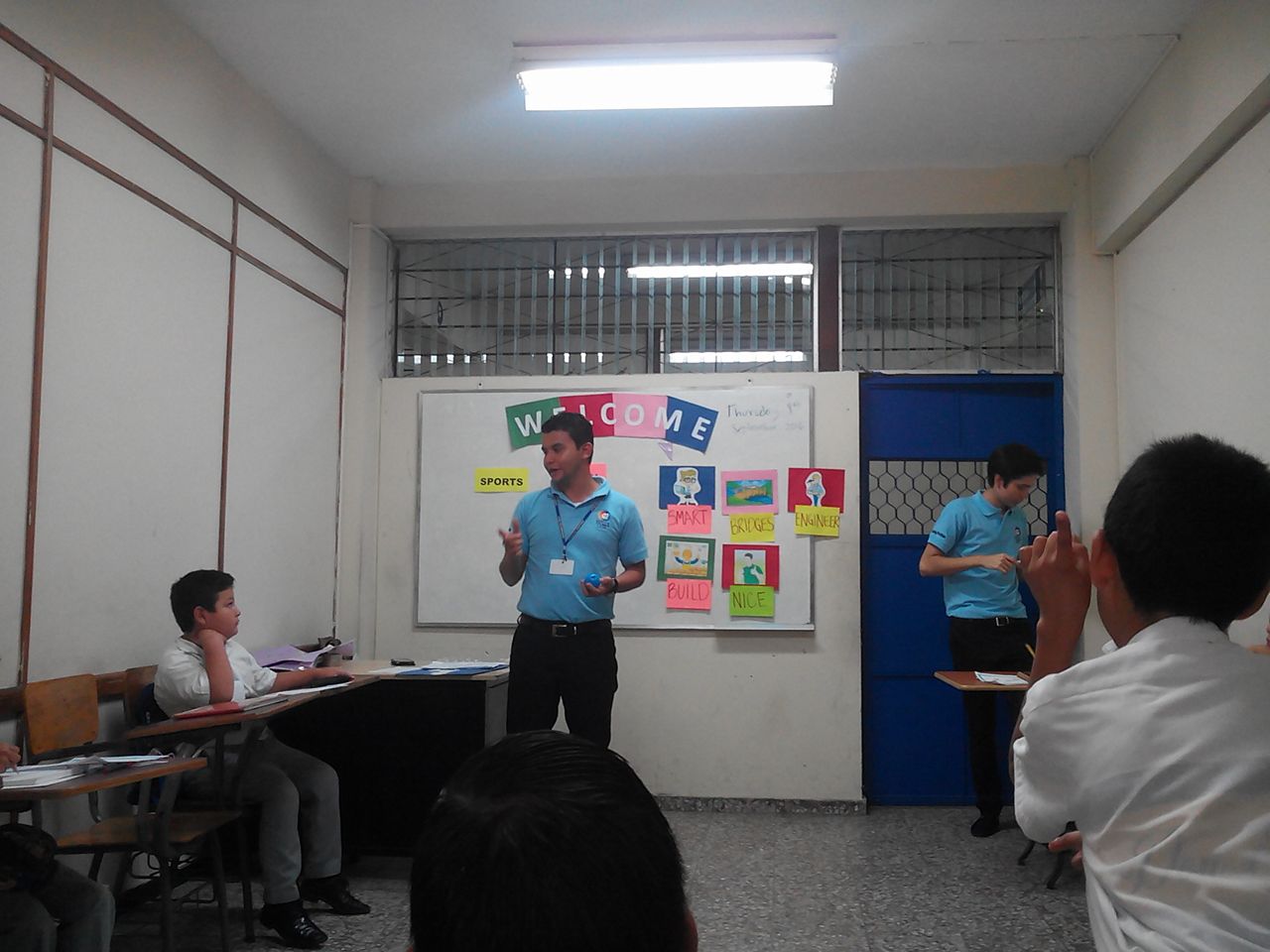
The way T Nelson introduced the topic to students was good. He greeted the kids and introduce himself and his partner. Then, they presented some flashcards with pictures and the labels with the words to students. It was about key vocabulary Ss will find in the text. Teachers present 5 words (nice, smart, engineer, build and Bridges). They motivated Ss to repeat the pronunciation and also to do the action of each word. T were pasting the pictures in the board but this time without the labels. T Cristian asked them to repeat the word again. Moreover, the labels were gave to Ss to match it with the correct picture T Cristian gave one to a kid and that kid felt motivated to go to the board and pasted it. There were other students who wanted to participate so T Nelson helped the other teacher to provide the flashcards to the Ss. When Ss finished to do it T could asked them to repeat one more time.


In the during-stage, T Cristian gave a reading to each student. Ss had to see the text and the images to have an idea or predict what the text is about. Some flashcards with three topic (sports, family and school) were pasted in the board. T Nelson asked them to raise their hand if they agreed with one of those categories. It was difficult to Ss to understand the instructions and just a few of them participate in the activity.
Furthermore, T Cristian asked Ss to read the whole passage. Both teacher were helping and monitoring the Ss reading process. When everybody finished to read they had to answer the questions that were above the text. Teachers also were helping Ss to clarify doubts and do the activity easily. T Nelson checked the answers by reading the questions and asked some Ss their answers.
In the next activity, some worksheets were provided to Ss. They had to fill in the blank spaces that were in some sentences with their personal information. One student finished really fast and T took his worksheet has an example and he explain again what they had to do. Teachers were monitoring Ss and they were checking the answers, too.
Finally, the wrap-up activity was a “pass the ball” game. T nelson gave a ball to Ss and they had to pass it until T Cristian stopped counting. The Ss who had it, when T stopped counting, passed to the front and point the picture of the vocabulary T Nelson asked for. Three students participated in this activity.
It was time to go and teacher said good-bye to Ss and give them a delicious snack, so they could enjoy it in their returning to CDB.


Look their lesson plan here: 

The family members (Listening)

Date: Tuesday, September 6th, 2016
Topic:The family members 
Framework: PDP
Skill: Listening.
Teachers’ name: Carlos Jovel
Guillermo Guerra

Todays’ class was really entertainment, the activities were really good and children liked a lot. First of all, T Charlie introduce himself and the other teacher that was Guillermo. T Guillermo gave some name tags to each children by calling his name, and Ss had to say present when he called them. Both teachers were helping Ss to put the name tag in his neck.
Continuously, T Charlie showed students some flashcards with four different commands that students should use in the class. T said and did the action of each command, so students could repeat the word and clarify the meaning of each one.
Moreover, T Guillermo was pasting some flashcards of family members while teacher Charlie was giving instructions about what Ss had to do in the warm-up activity. It was a bow and arrow game. Before started the activity, T reviewed the family members just to refresh the vocabulary students learned in the previous class. There were two groups and each student of the groups had to shoot with the arrow to the correct family member that T Charlie mentioned. Every student took turns to pass in front and shoot, but just two boys were the ones who could shoot correctly to the family member. When the game finished T gave a cookie to the winners.


In the pre-listening part, T Guillermo pasted a chart in the board. He showed some questions and answers in the chart and he wanted students to use the phrases with the correct pronoun. It was difficult to children because they did not acknowledge where or when to use each of the different questions and answers. T Guillermo tried to reuse the same flashcards of the warm-up activity in the presentation, so he decided to ask the questions, but this time showing the family member that helped Ss to identify the pronoun they had to use and the answer they had to say.
The next activity was a memory game. T Guillermo asked Ss to stand up and make two lines. T pasted the flashcards facing down the board. T Charlie explained the activity and he asked T Gabriela and T Paolo to stand up. T clarified to Ss when to use “she” (with girls like Gaby) and when to use “he” (with boys like Paolo).Then, T Guillermo asked one student to choose two flashcards that could have the same picture. T mentioned the family members that were in the cards, so Ss could keep in mind the picture and then when it was their turn they could chose the ones that were the same. Every students participated in this activity, but just a few of them could remember and choose the flashcards that had the same family member.


The during-listening stage was kind of difficult because teachers had some problems with the audio, thereby they improvised and read what was in the audio. Also. they helped students to do the exercises in a worksheet. Some worksheets were provided by the teachers. In the first part, children had to write the words that were missing in a conversation (who, she, he, etc.) according how they listened in the audio. T Guillermo was monitoring student while they were writing. In the second activity, they circled the family members they listened from teacher Charlie. This part was easier than the other one and students did it well.
Finally, T Guillermo gave a half of a page to children. He asked them to draw their family members in it. When they finished some Ss stood up and interact with the students that were sit by asking and answering the questions they learned and also showing and pointing the family member in their drawing.
At the end of the class, teachers gave some candies and a cookies to the kids, and they said good-bye to them.
In the following file you can check the lesson plan of this listening class:

Monday, September 5, 2016

Possessive adjectives.

Date: Thursday, September 1st, 2016
Topic: possessive adjectives.
Framework: PPP
Skill: grammar.
Teachers’ name:  Paolo Mazariego
Gabriela Callejas.

T Gaby started the class giving a name tag to each student. Then, teacher Paolo greeted them and asked them to stand up to started the warm-up activity.
In the warm up activity, T Paolo planned to sing a chant with the students to review the family members’ vocabulary they learned in the previous class. To have a more interactive activity, he pasted a poster with the lyrics in the board, so Ss could follow the lyrics and sing it with the teacher. It encouraged students to participate in the activity.
To present the grammar structure “possessive adjectives” T Paolo showed some labels with different possessives (my, your, his, her). He also showed the object pronouns that correspond to each possessive, so Ss could compare and understand better the differences between them. T asked students to repeat the new words as necessary as possible to get the pronunciation of them. Moreover, T Paolo asked some ss to go to the board and match the labels of possessives with the correct sentences that T Gabriela wrote in the board.

You can see a short part of the presentation here:

It was time to practice and T Paolo provided Ss a worksheet where they had to fill in the blanks using possessive adjectives. There were some sentences with a pronoun in parenthesis, so students could relate the pronouns with the correct possessive they had to write in the blank space. Also, there were some pictures to facilitate the exercises with visual aids to learners.
In the production stage, T Gabriela gave each student a piece of paper either blue, yellow or green and the students who had the same color had to sit and work together. She gave each group one flashcard and they had to ask each other the question “who is that/this?” Students made some mistakes because they were not sure about what possessive adjective say and if it was correct. After each member of the group participated T Gaby changed the flashcards of the groups, and Ss had to do the same using the new picture. 
Furthermore, T asked two pairs to pass in front and have a short conversation like they did previously. T helped and correct ss when they made mistakes.


Finally, T Gaby used the flashcard to check Ss new knowledge. She showed the pictures and Ss said the correct adjective if they mispronounce or say the incorrect one T correct them.
When the class was over both teachers gave a snack to Ss and say good-bye. 
Lets’ see their lesson plan here: